Something structural is happening in Southeast Asia's data center map right now, and most of the region's traditional hubs are on the wrong side of it.
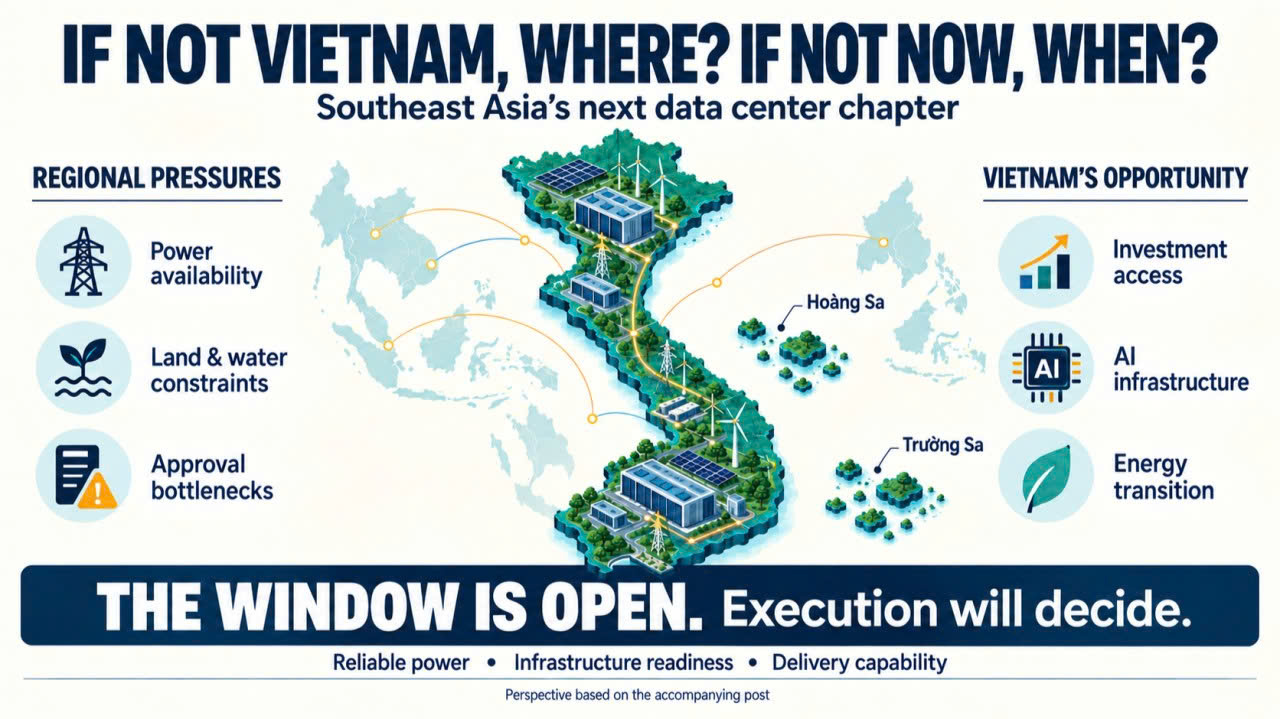
Over the past 18 months, the four markets that absorbed almost all of ASEAN's hyperscale and AI infrastructure capital — Singapore, Malaysia, Thailand and, to a lesser extent, Indonesia — have each hit a wall of land, water or power. Governments that used to compete on how fast they could approve a new campus are now competing on how carefully they can slow one down. Meanwhile Laos and Cambodia, historically bystanders in this story, are actively opening their doors, and Vietnam has spent the same 18 months doing the opposite of everyone else: removing conditions instead of adding them.
For anyone advising investors, developers, or governments on where the next wave of Southeast Asian digital infrastructure lands, the question in the title is not rhetorical. It is the live question.
Singapore: rationing, not growth
Singapore has operated under a data center moratorium since 2019 on space and power grounds. The first controlled release, in 2023, handed out just 80MW across four operators. Its long-awaited second call for applications (DC-CFA2), opened in December 2025 promising "at least 200MW," closed in August 2026 with exactly 200MW provisionally awarded to four operators — an outcome Fitch Ratings said "falls well short of the capacity sought by competing proposals," with Singapore occupancy already above 95%.
On top of that, Singapore's Energy Market Authority effectively caps data centers at roughly 12% of national grid load, a proposed Digital Infrastructure Bill would require an IMDA license for any third-party facility above 10MW, and the carbon tax climbed to S$45 per tonne of CO2e from 1 January 2026, on its way to S$50–80 by 2030. Singapore is still the region's control center for connectivity and capital — DC Byte now describes it as a "control tower" rather than a place that absorbs bulk capacity — but it is no longer where a new scale gets built.
Malaysia: quietly closed to anything that isn't AI
Malaysia absorbed most of the overflow demand Singapore couldn't accommodate. That window is narrowing too. On 24 February 2026, Prime Minister Anwar Ibrahim told Parliament the government "has limited the entry of new non-AI-related data centres for the past couple of years"— a restriction quietly in force since roughly 2024 .
Johor, which hosts around 60% of Malaysia's targeted 2030 capacity, has rejected close to 30% of applications since mid-2024 over water and power sustainability concerns, and its Menteri Besar said in March 2026 that the state will now approve only air-cooled Tier 3/4 projects, flatly refusing anything with high water demand. The bigger bottleneck may be delivery: as of March 2026, national utility TNB had contracted 8.3GW of data center demand but only 1,054MW — about 23% — was actually drawing power. Wood Mackenzie warns Johor's data centers could consume 40% of state electricity demand by 2035, and Sarawak's premier said in July 2026 the state is now "more selective," questioning whether data centers will even remain essential in five to ten years given how few jobs they create.
Thailand: from fastest-growing pipeline to a construction freeze
Thailand's reversal has been the sharpest of all. On 4 September 2026 — six days before this piece was written — Thailand suspended construction on 49 data centers while regulators draft new rules on environmental and resource impact. That followed an April 2026 halt on new Board of Investment applications, a draft power development plan capping data center growth at roughly 8,000MW, and a new "four-pillar" screening framework covering energy, water, environment and domestic benefit. Of the projects the BOI had already approved, only 16 had actual confirmation that electricity could be supplied. In July 2026 the government also confirmed a separate, higher electricity tariff specifically for data centers, so AI and cloud demand stops pushing up household bills, and a new rule imposes a three-year shareholder lock-up on data center investors from the date power actually starts flowing. This lands on a huge in-flight book: Bangkok's under-construction capacity had surged 148% in the first half of 2026 alone — capital that now has nowhere obvious to go.
Indonesia: the problem is delivery, not appetite
Indonesia hasn't imposed a moratorium — its constraint is execution. Grid interconnection there takes three to five years against a one-to-two-year construction cycle, and the country is projected to face a roughly 1GW data center shortfall by 2030. Industry executives told the Jakarta Post in early September 2026 that customers are waiting six months to a year for supply because of import and permitting bottlenecks, even as Jakarta's pipeline grew 56% in H1 2026 to 1,699MW. Real capital is still moving — BDx secured a 1.2GW power portfolio with PLN in June 2026, and DayOne signed Indonesia's largest-ever PPA at roughly 450MW in April 2026 — but the friction is real, not imagined.
Laos and Cambodia: small, but actively courting the capital everyone else is turning away
This is the part of the story most people miss. Laos's 2026–2030 investment plan has formally put data centers and AI alongside renewables in its priority sectors, explicitly leveraging the country's abundant hydropower. Vientiane has signed MoUs for feasibility studies into a green-energy AI Innovation Center and a dedicated AI Special Economic Zone of more than 150 hectares, and its energy ministry is deliberately redirecting hydropower away from crypto mining and toward AI data centers, metals refining and EVs, telling Reuters that crypto "doesn't create value compared to supplying it to industrial or commercial consumers". Nothing at hyperscale investment level has been signed yet — this is still MoUs and studies, not shovels.
Cambodia is a step ahead operationally: it broke ground in mid-2026 on a US$30 million, 12-storey national data center targeting Tier IV certification, and Japan's erex received government approval in August 2026 to build a 170MW renewable-powered data center complex in Pursat Province, combining hydro, biomass and solar. Both countries are starting from a tiny base — Cambodia's entire installed capacity was estimated at roughly 7MW as recently as late 2024 — but the direction of travel is unmistakable: while Bangkok freezes 49 projects, Phnom Penh and Vientiane are actively pitching for the capital that used to have nowhere else to go but the big four.
Vietnam: the only large market removing conditions instead of adding them
This is the contrast that should be the headline for anyone allocating capital in the region right now. While its neighbors have spent 2025–2026 tightening rules, Vietnam has spent the same period dismantling them.
Ownership and licensing: Vietnam already permits 100% foreign ownership of data center, cloud computing and OTT services under its 2023 Telecommunications Law, effective mid-2024. A foreign investor can wholly own and operate a Vietnamese data center subsidiary today, with no cap. And under the new Investment Law effective 1 March 2026, data center services have been struck entirely from the conditional business list, removing the approval layer that still exists almost everywhere else in the region.
Tax and incentives: The Law on Digital Technology Industry, effective 1 January 2026, gives AI data centers a 10% corporate income tax rate for 15 years, with an initial exemption period. Decision 2161/QD-TTg shifts the country's digital infrastructure model from state-led to private-sector-driven, targeting at least 50% of national data center capacity from private green operators, at least two global technology giants investing directly, and at least four new international submarine cable routes owned by private players — all by 2030.
Power: usually the constraint, here becoming the differentiator. Decree 243/2026, issued in June 2026, made data centers eligible for synthetic direct power purchase agreements through the national grid and lifted the tariff cap on private-grid DPPA transactions. The revised national power plan (PDP8) raised Vietnam's 2030 installed capacity target to as much as 236,363MW, an increase of up to roughly 80,000MW over the prior plan, driven mainly by solar and wind. Vietnam has even revived nuclear power, ratifying an intergovernmental agreement with Russia in 2026 for the 2.4GW Ninh Thuan 1 plant. To be fair to the skeptics, legal commentators still flag that "a sufficient and stable green energy supply for data centers remains an obstacle" to Vietnam's regional hub ambitions — this is a genuine gap to watch, not a solved problem.
The pipeline is already moving. Viettel IDC is building a 140MW hyperscale facility in Cu Chi, Ho Chi Minh City. CMC Corporation is investing US$250 million in a hyperscale center in Saigon Hi-Tech Park. Abu Dhabi's G42 announced a US$2 billion hyperscale project with FPT, VinaCapital and Viet Thai Group. Singapore's Evolution, together with Hathor and Frontier, committed over US$500 million to a new Ho Chi Minh City campus, and Sembcorp Development received approval for a 90MW campus through its StarMason joint venture. NVIDIA and the Vietnamese government signed a cooperation agreement in December 2024 to build an AI research center and data center, and by mid-2026 NVIDIA said it aims to grow its Hanoi R&D center into a "world-class AI engineering hub," reporting roughly 130% growth in its Vietnam business over the prior year.
The economics are compelling. Vietnam's data center construction costs run around US$7.1 million per megawatt versus an APAC average of US$10.1 million and Japan's US$16.1 million, while yield on cost — at 17.5–18.8% — ranks second in the region behind only Singapore. Ho Chi Minh City alone had a 68MW pipeline against roughly 33MW of operational capacity as of mid-2026, more than doubling existing supply.
The honest caveat: Vietnam is not yet a mature market. Total operational capacity is still only around 100MW — roughly a tenth the scale of the region's leaders — and Moody's classifies Vietnam, alongside the Philippines, as an "early-stage" data center market, distinct from Singapore and Malaysia, which have already captured the bulk of economy-wide benefit. That is precisely the point. Early-stage is exactly where the best risk-adjusted returns get made — before the tax breaks tighten, before land prices catch up, before the queue gets long.
Why the window is now
Look at what has changed in the space of a single year. Singapore is handing out capacity by the hundred megawatts through a competitive process. Malaysia has quietly turned away non-AI investment for two years running. Thailand froze 49 live construction projects in the first week of September 2026. Indonesia's bottleneck is measured in years of grid queue time. Cushman & Wakefield's own regional data confirms the pattern at the macro level: Southeast Asia now holds roughly half of all under-construction data center capacity in Asia-Pacific, electricity availability has become "the industry's primary bottleneck," and development is "increasingly shifting beyond established hubs into peripheral locations and emerging markets with greater power accessibility".
Laos and Cambodia have noticed and are positioning for the overflow — but they are years behind on grid scale, sovereign risk profile and hyperscale-grade infrastructure. Vietnam is the only market in the region large enough to absorb serious hyperscale capital that has, in the same period, stripped away foreign-ownership limits, removed data centers from its conditional-investment list, cut the corporate tax rate for AI data centers to 10%, opened direct power purchase agreements to data center operators, and lined up nuclear and tens of gigawatts of renewables behind it.
None of that guarantees Vietnam wins the next five years of Southeast Asian data center investment by default. Power delivery still needs to catch up to policy ambition, and the operational base is small enough that execution risk is real. But policy windows like this — where every regional competitor is simultaneously closing doors that Vietnam is simultaneously opening — do not stay open indefinitely. Regulatory sentiment can tighten in Hanoi too, once land and grid pressure start to bite the way they now bite in Johor and Bangkok.
So the question for investors, developers and hyperscalers scanning Southeast Asia for the next site is not whether Vietnam belongs in the conversation. The data already puts it there.
Original post: https://www.linkedin.com/pulse/vietnam-where-now-when-quynh-pham-hnxic/
Reference List:
Data Centre Dynamics. (2024, May 31). Singapore’s government proposes data center licensing regime. Data Centre Dynamics. https://www.datacenterdynamics.com/en/news/singapores-government-proposes-data-center-licensing-regime/
Singapore Economic Development Board. (2026, August 20). Four data centre proposals selected as part of second data centre - call for application (“DC-CFA2”). EDB Singapore. https://www.edb.gov.sg/en/news-and-insights/four-data-centre-proposals-selected-as-part-of-second-data-centre
Fitch Ratings. (2026, August 26). Singapore's capacity constraints steer data centre growth to Malaysia. Fitch Ratings. https://www.fitchratings.com/research/corporate-finance/singapores-capacity-constraints-steer-data-centre-growth-to-malaysia-26-08-2026
Taylor, C. (2026, July 17). ASEAN's AI race is officially underway. Asia Times. https://asiatimes.com/2026/07/aseans-ai-race-is-officially-underway/
National Climate Change Secretariat. (2026, July 9). Carbon tax. NCCS Singapore. https://www.nccs.gov.sg/singapores-climate-action/mitigation-efforts/carbontax/
Tan, T. (2026, January 20). Five structural shifts reshaping data centre growth across Asia Pacific. DC Byte. https://www.dcbyte.com/news-blogs/apac-data-centre-market-shifts-2026/
Ragu, D. (2026, February 24). National grids can still supply enough power for data centres, says PM. Free Malaysia Today. https://www.freemalaysiatoday.com/category/nation/2026/02/24/national-grids-can-still-supply-enough-power-for-data-centres-says-pm
Asian Water. (2024, October 11). Malaysia halts new non-AI data centres over resource concerns. Asian Water. https://asianwater.com.my/malaysia-halts-new-non-ai-data-centres-over-resource-concerns/
The Straits Times. (2024, June 23). Johor rejects nearly 30 per cent of data centre applications to protect local resources. The Straits Times. https://www.straitstimes.com/asia/se-asia/johor-rejects-nearly-30-per-cent-of-data-centre-applications-to-protect-local-resources
Malay Mail. (2026, March 10). Johor MB Onn Hafiz: No approval for data centres with high water demand, welfare comes first. Malay Mail. https://www.malaymail.com/news/malaysia/2026/03/10/johor-mb-onn-hafiz-no-approval-for-data-centres-with-high-water-demand-welfare-comes-first/212089
Tenaga Nasional Berhad. (2026, August 10). News clip document [File PDF]. TNB. https://www.tnb.com.my/assets/newsclip/10082026d.pdf
The Edge Malaysia. (2024, June 14). Johor sets up committee to coordinate data centre green requirements. The Edge Malaysia. https://theedgemalaysia.com/node/807442
Sarawak Tribune. (2024, August 28). Premier: Data centre approvals to hinge on economic value. Sarawak Tribune. https://www.sarawaktribune.com/premier-data-centre-approvals-to-hinge-on-economic-value/
The Straits Times. (2024, September 10). Thailand freezes 49 data centres as resource fears escalate. The Straits Times. https://www.straitstimes.com/asia/se-asia/thailand-freezes-49-data-centres-as-resource-fears-escalate
The Nation Thailand. (2024, November 18). BOI shapes incentives to fuel data centre boom. The Nation Thailand. https://www.nationthailand.com/business/tech/40070483
Energy Connects. (2026, July 5). Thailand plans higher power tariffs for data center owners. Energy Connects. https://www.energyconnects.com/news/utilities/2026/july/thailand-plans-higher-power-tariffs-for-data-center-owners/
MCG Asia. (2026). Thailand data centre rules 2026: New requirements. MCG Asia. https://www.mcg-asia.com/featured-insights/thailand-data-centre-rules-2026-new-requirements
Cushman & Wakefield. (2026, August 18). APAC data centre market update H1 2026. Cushman & Wakefield. https://www.cushmanwakefield.com/en/singapore/news/2026/08/apac-dc-h1-2026
Global Data Center Hub. (2024, October 2). Indonesia's data center market hits new milestones. Global Data Center Hub. https://www.globaldatacenterhub.com/p/indonesias-data-center-market-hits
The Jakarta Post. (2026, September 3). Indonesia's data center push gains ground, but faces execution test. The Jakarta Post. https://www.thejakartapost.com/business/2026/09/03/indonesias-data-center-push-gains-ground-but-faces-execution-test
DayOne Data Centers. (2024, November 15). DayOne signs Indonesia's largest 511MVA / 450MW PPA to expand hyperscale data center platform in Batam. DayOne DC. https://dayonedc.com/markets/dayone-signs-indonesias-largest-511mva-450mw-ppa-to-expand-hyperscale-data-center-platform-in-batam
PR Newswire Asia. (2025, May 22). BDx Data Centers secures Indonesia's largest data center power commitment at 1.2 GW, strengthening strategic partnership with PLN across national AI infrastructure platform. PR Newswire. https://en.prnasia.com/releases/apac/bdx-data-centers-secures-indonesia-s-largest-data-center-power-commitment-at-1-2-gw-strengthening-strategic-partnership-with-pln-across-national-ai-infrastructure-platform-535727.shtml
The Star. (2026, August 18). Laos eyes data centres, AI in investment push. The Star. https://www.thestar.com.my/aseanplus/aseanplus-news/2026/08/18/laos-eyes-data-centres-ai-in-investment-push
Lao News Agency. (2024, October 30). Ministry of Technology and Communications highlights digital transformation progress. KPL Lao News Agency. https://kpl.gov.la/En/detail.aspx?id=91710
Reuters. (2025, October 16). Laos plans to pull plug on crypto miners by early 2026. Reuters. https://www.reuters.com/sustainability/boards-policy-regulation/laos-plans-pull-plug-crypto-miners-by-early-2026-2025-10-16/
Data Centre Dynamics. (2024, December 12). Cambodia breaks ground on national data center. Data Centre Dynamics. https://www.datacenterdynamics.com/en/news/cambodia-breaks-ground-on-national-data-center/
Baker McKenzie. (2026, June 18). Vietnam: Decree No. 243/2026/ND-CP on enhanced renewable energy DPPA framework. Baker McKenzie Insight. https://www.bakermckenzie.com/en/insight/publications/2026/06/vietnam-decree-no-243-2026-nd-cp-enhanced-renewable-energy-dppa-framework
eREX Co., Ltd. (2024, July 25). eREX enters into power purchase agreement for biomass energy in Vietnam [Press release]. eREX. https://www.erex.co.jp/en/news/pressrelease/788/
Knight Frank. (2024, December). Data centres: The Cambodia report [Report PDF]. Knight Frank Research. https://content.knightfrank.com/research/2946/documents/en/data-centres-the-cambodia-report-december-2024-11773.pdf
UNCTAD. (2024, November 5). Viet Nam allows full foreign ownership in the data centre, cloud computing and over-the-top (OTT) services sectors. Investment Policy Monitor, UNCTAD. https://investmentpolicy.unctad.org/investment-policy-monitor/measures/5058/viet-nam-allows-full-foreign-ownership-in-the-data-centre-cloud-computing-and-over-the-top-ott-services-sectors
Asia Counsel. (2026, January). Vietnam data centre guide (3rd ed.) [File PDF]. Asia Counsel. https://asia-counsel.com/wp-content/uploads/2026/01/Data-Centre-Guide_3rd-edition.pdf
Deloitte Tax@Hand. (2025, December 18). Vietnam: Law introduces incentives to support digital technology sector as from 1 January 2026. Tax@Hand. https://www.taxathand.com/article/39070/Vietnam/2025/Law-introduces-incentives-to-support-digital-technology-sector-as-from-1-January-2026
JD Supra. (2025, November 10). Vietnam embraces digital infrastructure. JD Supra. https://www.jdsupra.com/legalnews/vietnam-embraces-digital-infrastructure-1424020/
DFDL. (2024, July 12). Vietnam: PDP 8 revised - Vietnam's 2030 installed power capacity targets. DFDL Legal & Tax Updates. https://www.dfdl.com/insights/legal-and-tax-updates/vietnam-pdp-8-revised-vietnams-2030-installed-power-capacity-targets/
Reuters. (2026, March 23). Russia, Vietnam agree deal on nuclear power plant construction. Reuters. https://www.reuters.com/business/energy/russia-vietnam-agree-deal-nuclear-power-plant-construction-2026-03-23/
VnExpress International. (2024, October 28). Vietnam's CMC to build $250m hyperscale data center. VnExpress. https://e.vnexpress.net/news/tech/vietnam-innovation/vietnam-s-cmc-to-build-250m-hyperscale-data-center-4914146.html
Reuters. (2025, July 10). UAE firm G42 plans $2 bln hyperscale data centre in Vietnam. Reuters. https://www.reuters.com/world/asia-pacific/uae-firm-g42-plans-2-bln-hyperscale-data-centre-vietnam-2025-07-10/
VietNamNet. (2025, November 14). Vietnam data centre boom draws billions USD as AI demand accelerates. VietNamNet Global. https://vietnamnet.vn/en/vietnam-data-centre-boom-draws-billions-usd-as-ai-demand-accelerates-2549357.html
The Investor. (2024, August 20). Sembcorp to develop 90MW data center in HCMC. The Investor. https://theinvestor.vn/sembcorp-to-develop-90mw-data-center-in-hcmc-d18734.html
TechNode Global. (2026, June 30). Nvidia aims to build Hanoi's R&D center into world-class AI engineering hub. TechNode Global. https://technode.global/2026/06/30/nvidia-aims-to-build-hanois-rd-center-into-world-class-ai-engineering-hub/
VietnamPlus. (2024, September 25). Vietnam emerges as Southeast Asia's next data centre hotspot. VietnamPlus. https://en.vietnamplus.vn/vietnam-emerges-as-southeast-asias-next-data-centre-hotspot-post323575.vnp
Viet Nam News. (2024, October 15). Viet Nam draws hyperscalers, cloud titans, AI players. Viet Nam News. https://vietnamnews.vn/economy/1797050/viet-nam-draws-hyperscalers-cloud-titans-ai-players.html
BusinessWorld. (2026, September 1). Instability of PHL electricity grid preventing data centers from achieving scale: Moody's. BusinessWorld. https://bworldonline.com/economy/2026/09/01/773926/instability-of-phl-electricity-grid-preventing-data-centers-from-achieving-scale-moodys/